



 Home > News > Industry News>Tire Pyrolysis Plant Selection Guide: Batch, Semi-Continuous, or Fully Continuous for 10–15 TPD and 30–50 TPD Projects
Tire Pyrolysis Plant Selection Guide: Batch, Semi-Continuous, or Fully Continuous for 10–15 TPD and 30–50 TPD Projects
Industry News / Date:September 3, 2026
How do you choose the right pyrolysis plant model?
Buyers usually start with one question: “I have 15 tons of waste tires a day — which pyrolysis plant do I need?” The answer, however, is rarely decided by the tonnage number alone. Raw material form, supply stability, automation needs, and budget all change the recommendation for the same daily capacity.
A batch pyrolysis plant, a semi-continuous pyrolysis plant, and a fully continuous pyrolysis plant can each process 15 TPD. But they differ in what goes into the reactor, how much labor and attention the operation needs, and how much the whole project costs. This guide maps each pyrolysis plant type to its capacity range and helps you match the right configuration to your actual project conditions.
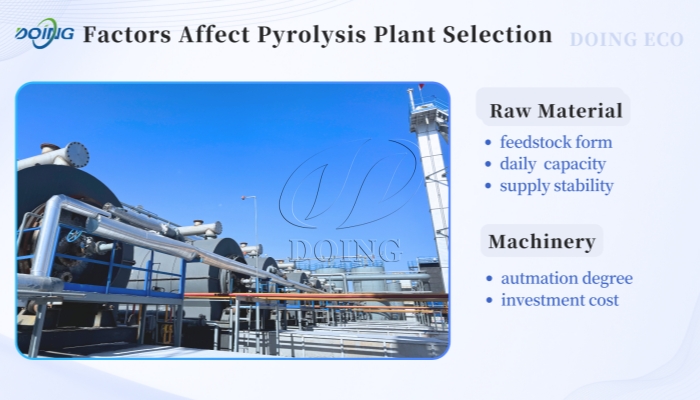
Factors affect pyrolysis plant selection
Four Pyrolysis Plant Types at a Glance
| Pyrolysis plant type | Capacity | Feedstock form | How it runs | Investment |
| Skid-mounted pyrolysis plant | 100 kg – 5 TPD | Small test batches of whole or pre-treated tires | Direct heating, simple manual operation; often used for trials and pilot validation | Low |
| Batch pyrolysis plant | 5 – 20 TPD | Whole tires can be loaded directly, or pre-cut for faster cycles | Batch cycle of about 22 hours each: load → seal → heat → condense → cool → discharge | Low–Medium |
| Semi-continuous pyrolysis plant | 5 – 20 TPD | Tires must be shredded before feeding | Enclosed screw feeding and hot slag discharge keep production running between cycles (about three runs in two days); 1–2 operators per shift | Medium |
| Fully continuous pyrolysis plant | 15 – 50 TPD | Tires must be processed into fine rubber powder | 24/7 enclosed operation under PLC control; no start-stop between batches | High |
Typical product yields from waste tire feedstock:
| Pyrolysis plant type | Pyrolysis oil | Carbon black | Steel wire | Syngas |
| Batch | 40–45% | 30–35% | ~15% | 6–10% |
| Semi-continuous | 46–50% | 40–42% | — (removed with shredding) | 10–12% |
| Fully continuous | 46–50% | 40–42% | — (removed in pre-processing) | 10–12% |
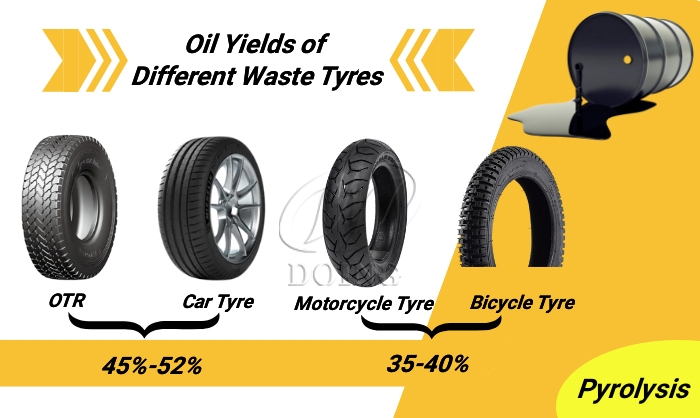
Pyrolysis oil yield of different waste tires
How to remember the difference in one sentence each:
Batch pyrolysis plant — the industry workhorse: simplest to run, tolerates irregular supply, and accepts whole tires without heavy pre-processing.
Semi-continuous pyrolysis plant — a batch-type pyrolysis plant upgraded with enclosed screw feeding and hot slag discharge: higher oil yield, less dust, fewer operators.
Fully continuous pyrolysis plant — a fully enclosed 24-hour production line: the highest automation and the most stable output, but it requires a rubber powder pre-processing line upstream.
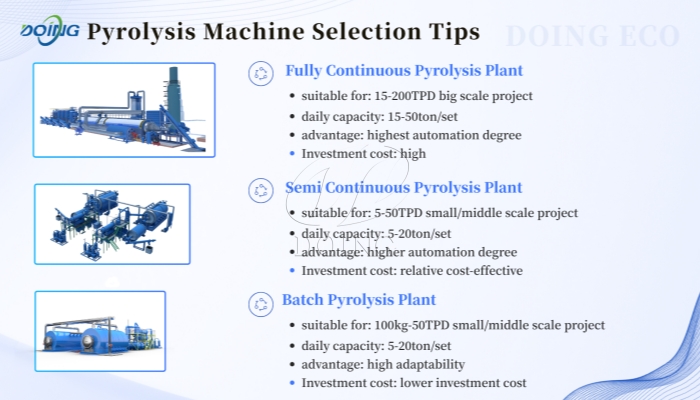
DOING ECO pyrolysis plant selection tips
10–15 TPD: Which Pyrolysis Plant Fits Best?
The 10–15 TPD range is the most common inquiry DOING ECO receives, and it is the only range where all three configurations can realistically apply. The deciding factors are supply stability and project stage:
| Your situation | Then… | Recommendation |
| Daily supply is stable and the project is commercial from day one | a semi-continuous pyrolysis plant gives roughly 5 percentage points higher oil yield than batch, needs fewer operators, and keeps the workshop dust-free | Consider the semi-continuous type first |
| Supply is still irregular, or you are piloting the business case | a batch pyrolysis plant accepts whole tires directly, pauses between batches without waste, and costs less upfront | Start with the batch type and upgrade later |
| You already secure fine rubber powder and want maximum automation | a 15 TPD fully continuous pyrolysis plant runs with the lowest per-ton labor cost, but requires a pre-processing line for rubber powder | Only if the extra front-end investment fits the budget |
If your supply is not yet stable, note that DOING ECO also supplies skid-mounted pyrolysis plants from 100 kg for feedstock testing, so you can verify local tire oil yields and product markets before sizing a commercial line.
30–50 TPD: Fully Continuous Pyrolysis Plant Is the Practical Answer
At 30–50 TPD, a single fully continuous pyrolysis plant is the configuration DOING ECO recommends for most industrial projects, for three reasons:
Scale economics. Reaching 30–50 TPD with batch or semi-continuous pyrolysis plants means running several parallel lines — more reactors, more condensing systems, more operators, and a larger site. A single 30, 40, or 50 TPD fully continuous line delivers the same daily output with one enclosed system.
Output consistency. Continuous operation produces stable daily volumes of pyrolysis oil and carbon black, which matters when buyers sign long-term offtake contracts. Batch start-stop cycles cause daily output fluctuations that contract buyers rarely accept.
Environmental performance. Fully enclosed feeding, pyrolysis, and slag discharge, combined with the PLC control system, keep dust and emissions low — a practical advantage when applying for environmental permits at industrial scale.
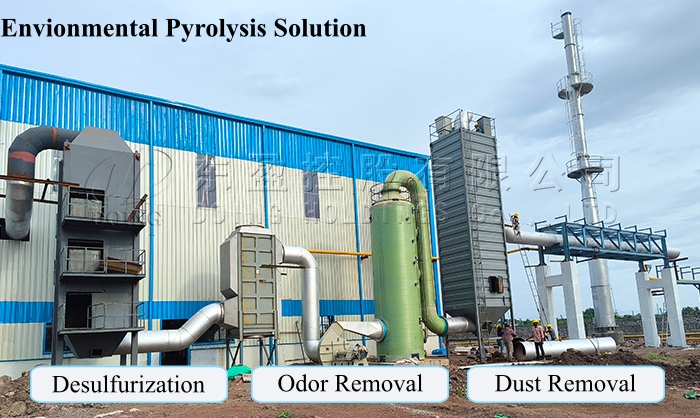
DOING ECO pyrolysis plant environment protection systems
A Five-Point Checklist for Your Tire Recycling Pyrolysis Project
Feedstock stability. If your daily volume is contracted and predictable, then continuous or semi-continuous operation is safe; if supply fluctuates seasonally, then the batch type lets you pause without loss.
Feedstock form. Whole tires → batch type accepts them directly. Shredded tires → semi-continuous (or batch) type. Fine rubber powder → fully continuous type. Your available feedstock form narrows the options immediately.
Budget. If capital is limited, then start with a batch or semi-continuous pyrolysis plant at 10–15 TPD; if the project is industrial-scale, then plan for the higher investment of a fully continuous line.
Labor and automation. If skilled operators are scarce or expensive in your region, then higher automation matters more; semi-continuous and fully continuous pyrolysis plants run with 1–2 operators per shift.
Project stage and expansion plan. If you are validating a new market, then begin small and scale up once supply and product sales are proven; DOING ECO’s four product lines are designed so a pilot can grow into a commercial line without changing suppliers.
Real Tire Pyrolysis Projects from DOING ECO
| Time | Project | Configuration and background |
| Jan 2026 | Kenya | A Chinese customer running asphalt mixing plants in Kenya bought a 15 TPD batch pyrolysis plant; the pyrolysis oil (calorific value comparable to diesel) will fuel his own plant boilers, cutting fuel costs |
| Jan 2025 | Myanmar | A limestone factory owner ordered three 15 TPD batch pyrolysis plants (45 TPD total) with automatic feeders and heavy-oil burners; the 42–45 MJ/kg pyrolysis oil is used in his own lime production — a “self-produced, self-used” energy model |
| May 2025 | Indonesia | A Singaporean entrepreneur with mining operations chose a 15 TPD semi-continuous pyrolysis plant: shredded tires are fed by an enclosed screw feeder and carbon black is discharged hot, keeping the workshop dust-free |
| Feb 2026 | India | A 50 TPD fully continuous pyrolysis plant in operation: tires are first processed into rubber powder with a crusher, shredder, magnetic separator (steel wire recovery above 98%) and vibrating screen; PLC control maintains 300–600 °C reaction temperatures |
| May 2025 | Shandong, China | A foreign-trade client importing shredded tire rubber powder installed a 50 TPD fully continuous pyrolysis plant with enclosed continuous feeding, pyrolysis, and slag discharge to meet national environmental standards |
| Jun 2026 | Ethiopia | An India-based timber trader ordered a 12 TPD batch pyrolysis plant with a tire cutting machine and carbon black briquette machine for a complete recycling solution |
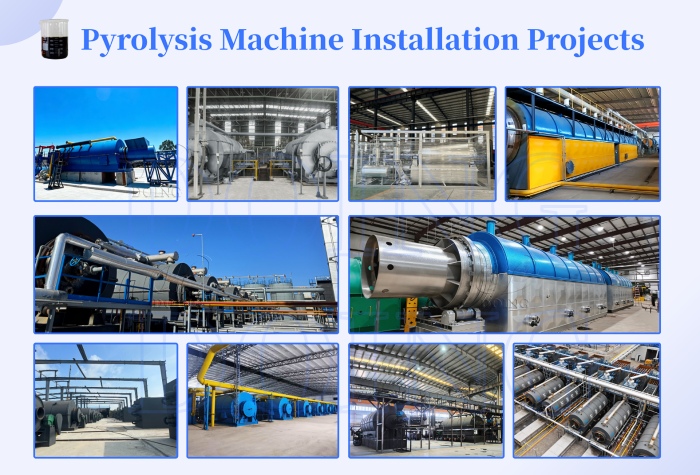
DOING ECO pyrolysis machine installation projects
More recently, DOING ECO signed a 50 TPD fully continuous waste tire pyrolysis plant project in Hai Phong, Vietnam, and a Senegal project supplying four 15 TPD units plus a 14 TPD pyrolysis oil refining line to produce alternative fuel for a steel mill.
The pattern behind these projects matches the guidance above: 10–15 TPD projects are served by batch or semi-continuous pyrolysis plants depending on supply stability and environmental requirements; 30–50 TPD industrial projects are served by single fully continuous lines.
Frequently Asked Questions
Can whole tires go directly into the pyrolysis reactor?
With a batch pyrolysis plant, yes — whole tires can be loaded directly, or pre-cut for shorter cycles. A semi-continuous pyrolysis plant needs shredded tires for its enclosed screw feeder. A fully continuous pyrolysis plant requires fine rubber powder, which means a pre-processing line (crusher, shredder, magnetic separator, vibrating screen) upstream. DOING ECO supplies these pre-processing machines as part of the complete project scope.
At 10–15 TPD, batch or semi-continuous tire oil pyrolysis line— which earns more?
The semi-continuous pyrolysis systems typically produces 46–50% oil against 40–45% for the batch type, and runs with fewer operators. If your supply is stable enough to keep it running, the higher yield usually justifies its higher price. If your supply is irregular or you are still testing the market, the batch type’s flexibility and lower upfront cost are worth more than the yield gap.
Why does the price of a pyrolysis plant vary so much?
Investment levels fall into four bands: low for skid-mounted and small batch pyrolysis plants; medium for 10–20 TPD batch and semi-continuous plants; medium-high for fully continuous plants at 15–20 TPD; high for fully continuous plants at 30–50 TPD. The main cost drivers are reactor steel grade and wall thickness, direct versus indirect heating, condensation capacity (water tank versus tubular), tail gas treatment, PLC automation, and the pre-processing equipment your feedstock requires.
What to Send DOING ECO for a Pyrolysis Project Recommendation
To configure and price a pyrolysis plant accurately, DOING ECO needs: your raw material type and form (whole tires, shredded, or rubber powder), estimated daily tons and supply stability, project location and applicable environmental standards, budget range, desired automation level, and whether auxiliary equipment (tire cutting, shredding, carbon black processing, oil refining) is required.
DOING ECO (Henan Doing Environmental Protection Technology Co., Ltd.) is a pyrolysis plant manufacturer specializing in waste tire, plastic, and oil sludge recycling, with skid-mounted, batch, semi-continuous, and fully continuous product lines. With a branch office in Nigeria and project references across more than 120 countries, DOING ECO provides feedstock testing, plant layout planning, on-site installation and commissioning, and long-term technical support. Certifications: CE, SGS, ISO 9001.
Request Information
Send your inquiry for further information