



 Home > News > Industry News>Is the pyrolysis process safe? How to ensure the safe operation of pyrolysis machines?
Is the pyrolysis process safe? How to ensure the safe operation of pyrolysis machines?
Industry News / Date:September 24, 2024
Generally speaking, the pyrolysis process is safe when three conditions hold at the same time: no air inside the reactor, pressure kept at or near atmospheric, and every ignition source outside the reactor shell. Fire needs fuel, oxygen and heat in one place, and a pyrolysis machine is arranged so that the three never meet — the feedstock breaks down inside a sealed, oxygen-free shell, the vapour is condensed as fast as it is produced, and the only flame burns in the furnace around the outside of that shell.

Three key conditions for pyrolysis safety
That means safety is decided in two places: in the design and configuration of the pyrolysis machine itself, and in how it is operated and maintained afterwards. The first half is the manufacturer's responsibility, and it is worth checking line by line before you sign. The second half is yours, and it only works if the first half was done properly.
In this article we walk through both halves, stage by stage. Where a specific arrangement makes the point clear, we use the configuration DOING ECO (Henan DOING Environmental Protection Technology Co., Ltd) builds, because that is the one we can describe from drawings rather than from a brochure.
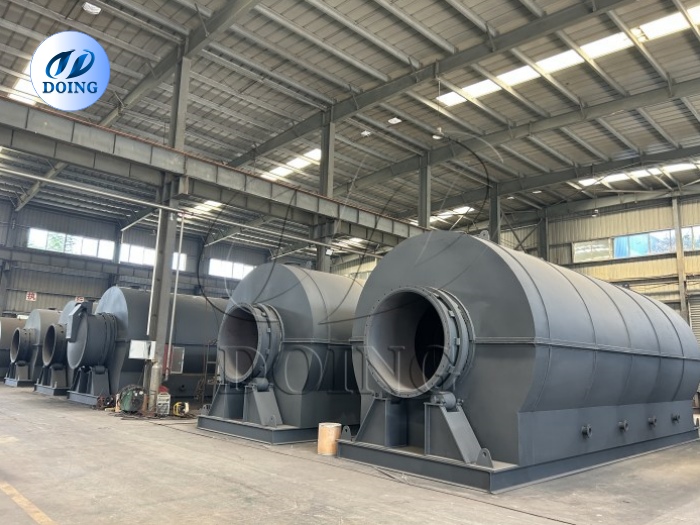
DOING ECO pyrolysis machine for sale
1. Equipment selection: what the machine must do at each stage
The pyrolysis machine is a chain, not a single vessel. Air, pressure or a stray spark can only get in at five points along that chain — feeding, the reactor and its heating, the vapour path, gas recovery and tail gas. Each point has a known failure mode and a known countermeasure, and the useful question for any pyrolysis machine manufacturer is which countermeasure they fit at each one.
| Stage | What can go wrong | What prevents it |
|---|---|---|
| Feeding | Air drawn in through an open door or a loose feed | Bolted door with heat-expanding graphite packing, or sealed screw and ball valve feeding |
| Reactor and heating | Overpressure, a weak weld at the head, the shell creeping backwards | Atmospheric operation, relief valves, one-piece formed heads, full-penetration welding, grooved rear support |
| Vapour path | Carbon black or wax blocking a condenser, so pressure builds behind it | Buffer tank with relief valve and gauge, dewaxing tank for plastics, oversized pipe, scheduled cleaning |
| Gas recovery | Gas flowing backwards into the reactor or the yard; a burner lit in the wrong order | Water seal and anti-backflow device on the gas line, oil seal at the feed inlet, electric ignition |
| Tail gas | A blocked flue path pushing pressure back into the line; acidic wash water | Scrubber, dust removal and SCR sized to the gas volume, wash water kept out of the furnace |
Feeding: the first place air gets in
On a batch pyrolysis machine, the feed door is the largest opening in the system — usually 1.4 m across, closed with a flange, 32 bolts and a graphite packing ring seated in a machined groove. Graphite expands as it heats, so the joint tightens itself during the run instead of loosening. It still needs to be re-tightened by hand at around 100 °C as the reactor warms up, and that routine is part of safe operation, not an optional extra.
On a semi-continuous or fully continuous pyrolysis machine, there is no open door at all: material travels in through an enclosed screw and a ball valve, so the reactor is never exposed to air while it is hot.
Feed specification is a safety item, although buyers often treat it as a quality item. A continuous pyrolysis machine needs 16–18 mesh rubber powder, or plastic below about 30 mm. Feed crumb or whole pieces and the screw cannot pack the material into a seal — air enters with every turn, and the reactor stops being oxygen-free. Water works against you the same way: moisture flashes to steam against a hot shell and shows up as pressure at the outlet.
The reactor and its heating: where manufacturing quality shows
The reactor runs at atmospheric pressure, normally held slightly below it, so it is not a pressure vessel in service — but it should be built to pressure-vessel practice, because it spends years being heated and cooled. The details are visible if you know where to look:
The heads. A one-piece ellipsoidal head, hot-spun to the GB150 standard and welded on with a specific angle groove and full penetration, carries roughly twice the safety factor of a conical head assembled from plates and hand-welded in place — the least consistent weld on any machine, in the position that takes the most stress.
The welding. Fully automatic submerged arc welding, a groove 10 mm deep or more, and a finished weld width of about 1.5 times the plate thickness. The plate itself is Q245R boiler steel, about 16 mm on a 15-tonne-per-day reactor; its lower carbon equivalent resists the wet hydrogen sulphide corrosion that tire work produces better than Q345R does. Steel plates made of 306/316 stainless steel are also available upon request.
The support. The rear of the shell sits in a grooved trolley that locks it axially. If the shell creeps backwards over a year of thermal cycling — and it will try — the groove takes the load instead of the gas outlet, which is the hottest, most heavily loaded joint on the machine.
The heat. A-grade non-combustible rock wool behind a refractory lining rated above 1,580 °C keeps the outer skin near 50 °C, so furnace heat never reaches the trunnions or the seals.

Manufacture of DOING pyrolysis machine
On top of the structure sit the pressure devices: a safety valve and relief valve, an electric-contact pressure gauge, a double water seal, and the negative-pressure system (a DOING ECO patented device) that keeps gas moving inward through any small leak rather than outward.
The vapour path: two blockages that turn into pressure
Vapour leaves the reactor and hits the buffer tank first. It is a simple vessel with an easy-to-underestimate job: it slows the gas down, gives it room to expand, and carries an automatic relief valve and a pressure gauge on top, so everything downstream sees a steadier flow.
Two things block the path after it, and both show up as pressure rather than as a quality problem. Carbon black carried over with the vapour settles in condenser tubes and narrows them. And wax: oil derived from plastics starts to solidify around 20 °C, so on a cool day or a long pipe run the wax sets on the tube wall while the reactor keeps producing gas into a closing line.
The countermeasures are mechanical, not procedural — a dewaxing tank or a second damping tank between the buffer tank and the condensers, larger pipe diameter for margin, and a cleaning interval written into the maintenance plan.
Gas recovery: burn it where it is made
The gas that does not condense goes back to the furnace as free fuel. It is also the part of a pyrolysis machine most often designed badly, so three rules are worth checking.
First, this gas is consumed on site, not stored. A gas bag or gas holder looks convenient, but the gas composition shifts with the feedstock and a stored volume of it is difficult to pass a fire-safety assessment in most jurisdictions. Burning it as it is produced removes the storage question entirely.
Second, the gas must not be able to travel backwards. Three devices handle that between them: a water seal on the gas line, a dedicated anti-backflow device — DOING ECO fits a patented gas backflow safety device (patent no. ZL 2019 2 0093901.8) at this point — and an oil seal at the feed inlet, so gas cannot push out through the feeding point.
Third, ignition order. A burner fed by pyrolysis gas should light itself: multiple lances, at least two with electric ignition, so the sequence is flame-before-gas. Where an operator opens the valve first and hunts for a flame, the gas arrives first and the result is a flash at the burner mouth.
Exhaust gas: why the flue is also a pressure issue
The exhaust is usually discussed as an environmental topic, but it belongs in a safety checklist too: if the flue path cannot pass the gas volume, the pressure has nowhere to go but back into the vapour line. A working chain runs air-cooled or cyclone dust removal first, then a pulse-jet bag filter, a caustic spray scrubber for sulphur, SCR at 280–360 °C for nitrogen oxides, and activated carbon before the stack — each stage sized to the actual gas volume, not to a standard drawing.
Two operating points keep that chain safe. Wash water must stay out of the furnace: oil-bearing water injected into the combustion chamber raises the load on the whole flue path, and sulphur plus water forms the acid that eats the stack and the fan. And the scrubber water itself must be recirculated or treated, never dumped.

Pyrolysis machine environmental protection devices
2. Operation, training and maintenance: keeping it safe after delivery
Two identical pyrolysis machines can be safe in one plant and a hazard in another, and the difference is almost never the steel. It is what the panel displays, what the operators were taught, and what gets checked on a schedule. These are the items worth confirming before the first run.
| Device | What it reacts to | Where it sits |
|---|---|---|
| Pressure gauge and electric-contact gauge | Outlet pressure, with an alarm contact | Top of the buffer tank, repeated on the control cabinet |
| Temperature gauges | Vapour outlet, furnace, reactor door | Control cabinet, plus a door thermometer for discharge decisions |
| Automatic relief valve | Overpressure in the vapour or gas line | Buffer tank top and the rear of the gas line |
| Double water seal | Reverse flow of gas | Gas line between the system and the furnace |
| Anti-backflow device and oil seal | Reverse flow at the gas line and the feed inlet | Gas line, feed inlet |
| Alarm bell | Any reading past its set point | Operator station |
| Forced-air cooling with vacuum | A reactor that must be opened before a full natural cooldown | Reactor shell |
| Emergency sand box | A small fire at a door or discharge port | Beside the reactor, within reach |
Operator training
Before the first run, the crew that will actually operate the pyrolysis machine — not only the site manager — should know four things: what normal looks like on the panel (outlet temperature and pressure, furnace temperature, cooling water flow), the correct order for lighting the gas burners, what to do when pressure climbs instead of falling, and the rules for opening the machine, which are about temperature and residual gas, not about the shift clock.
[Image: Operation guidance and training provided by DOING engineers]
DOING ECO provides this training with the machine: once the project configuration is confirmed, factory engineers deliver safe-operation guidance on site during installation and commissioning, so the procedures match the actual panel and the actual valves in front of the crew.
Daily maintenance
A pyrolysis machine runs hot for long hours every day, so maintenance is not optional. Motors, oil pumps and bearings need lubrication on schedule. Pipelines need periodic cleaning, because carbon black impurities settle at the bottom of the vapour lines during long runs — left alone, they cause blockage, gas stagnation and then pressure, which is exactly the failure the relief devices exist for. Door and discharge packing should be on a weekly walk-round: a weeping gasket is a small fault that becomes a serious one, and the packing screws are the parts that must be re-tightened while the machine is hot.

Pyrolysis machine regular maintenance
Fire prevention and emergencies
The rest of the checklist is deliberately low-technology. Fire extinguishers and, where the site requires them, automatic sprinkler systems; an emergency sand box next to the reactor, because a fire at an opening is smothered, not chased with water; sealed carbon black discharge through a water-jacketed screw or into sealed bags, since dust is a health issue first and a fire issue second; and continuous monitoring of temperature, pressure and gas emissions so anything abnormal is caught early.
All in all
The pyrolysis process is safe when the pyrolysis machine is built around the five points above and run with the discipline the second half describes. If you are comparing machines, you do not need to audit a factory to tell them apart — ask each manufacturer how the reactor is sealed when hot, what protects the shell if pressure rises, what happens when a condenser blocks, where the non-condensable gas goes, and what the flue chain is sized to. Specific answers mean a machine designed around safety; vague ones mean a machine assembled around a price.
DOING ECO builds batch, semi-continuous and fully continuous pyrolysis machines from 100kg to 50 tonnes per day and ships them to more than 120 countries, so these same questions arrive from buyers in very different regulatory settings — and the five points behind them never change. Send us your feedstock, the form it arrives in, your daily tonnage and your site conditions, and our engineers will tell you which of the five points changes with your material and which safety devices come with the configuration they propose.

Guide and training services provided by DOING

DOING pyrolysis machines installed in various countries
FAQ
Does the pyrolysis reactor count as a pressure vessel?
No. The reactor runs at atmospheric pressure, and operation aims at a slight vacuum rather than a build-up, so it is not designed or rated as a pressure vessel. The shell is still built to pressure-vessel practice — boiler plate, one-piece ellipsoidal heads formed to the GB150 standard, full-penetration welds — because it has to survive years of heating and cooling. If your local authority classifies it differently, settle that with the inspector before you order rather than after delivery.
Can wet or mixed feedstock raise the risk inside the reactor?
Yes, and it is one of the most common causes of an unstable run. Water flashes to steam the moment it touches a hot shell; inside a sealed reactor that steam adds volume and appears as pressure at the outlet. Mixed feed brings a second problem: PVC and PET do not convert to oil and release corrosive gas instead, and oversize lumps stop a feed screw from sealing. Drying, sorting and sizing the feed is cheaper than any safety device you can buy.
Which parts of a pyrolysis machine wear first?
Seals and discharge hardware. The graphite packing at the door and the discharge port, the packing screws, the discharge screw and the burner lances all live in heat and abrasion. These belong on a weekly walk-round rather than on a calendar, because the packing in particular has to be re-tightened while the machine is hot, at around 100 °C.
What should an operator do if pressure climbs during a run?
Stop or reduce feeding first, then look for the two usual causes: a condenser narrowing from carbon black or wax, and a flue path that cannot pass the volume. Watch the buffer tank gauge and the relief valve — the valve is there to open, not a sign of failure — and never open the reactor to "release" pressure while it is hot. Every crew should rehearse this sequence during commissioning, before the machine runs.
Are the safety systems the same on batch and continuous pyrolysis machines?
No. A batch pyrolysis machine protects itself through procedure: it opens once per cycle, after forced cooling to below about 70 °C, with residual gas vented first. A continuous pyrolysis machine never opens while hot — sealed screw feeding, water-cooled discharge — so protection moves into interlocks, displayed pressure and temperature, and automatic relief. One relies on disciplined operators, the other on disciplined maintenance.
Request Information
Send your inquiry for further information