




How to Adapt a Pyrolysis Plant to Local Regulations?
Industry News / Date:October 23, 2026
There is no single pyrolysis plant configuration that clears every jurisdiction. The same pyrolysis plant that passes review in one country can stall in the next, because emission limits, feedstock rules and permit types all move with local law. Adapting a pyrolysis solution runs in four steps: find out which authority regulates what in your district, configure the gas treatment train to those limits, assemble the EIA and permit documents, and leave room for tighter rules later. The middle two steps carry most of the work, and they are the ones a pyrolysis plant manufacturer takes part in.
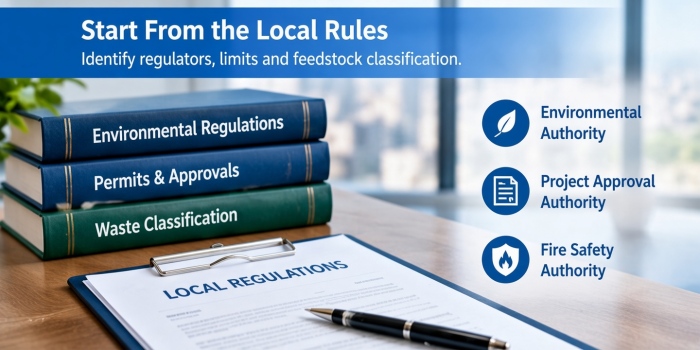
Pyrolysis plant configurations should meet local environmental and safety requirements
I. Start From the Local Rules, Not From the Machine
Before comparing offers, identify who regulates what. Most projects answer to a local environmental authority for air emissions, water and waste handling, and to a separate body for project approval; fire safety often sits with a third. In practice that means three separate conversations, not one approval.
Feedstock classification belongs on the same page. In some jurisdictions waste tires or mixed waste plastics count as solid waste, in others as hazardous waste, which changes the licence type and the storage requirements. A configuration quoted before those two documents exist is a guess; the limit list and the feedstock classification decide the rest.
Those three items are also the brief a manufacturer needs. Send the limit list, the feedstock classification and the planned tonnage together, and the configuration can be quoted against real numbers instead of a generic offer. Sent separately, they usually come back as three rounds of questions.
II. Match the Gas Treatment Train to the Limits
A pyrolysis plant does not vent its process gas. Oil vapour from the reactor is condensed into pyrolysis oil, and the non-condensable gas is piped back to the burner and used as fuel for the reactor itself. Nothing on the process side goes straight to atmosphere, which is the first thing an EIA reviewer looks for.
Cooling is closed for the same reason. On the lines DOING ECO builds, the circulating cooling water system sends the same water back to the condensers after it passes the tower, so there is no process wastewater to discharge and only make-up water is added. That detail removes a whole permit category from most projects.
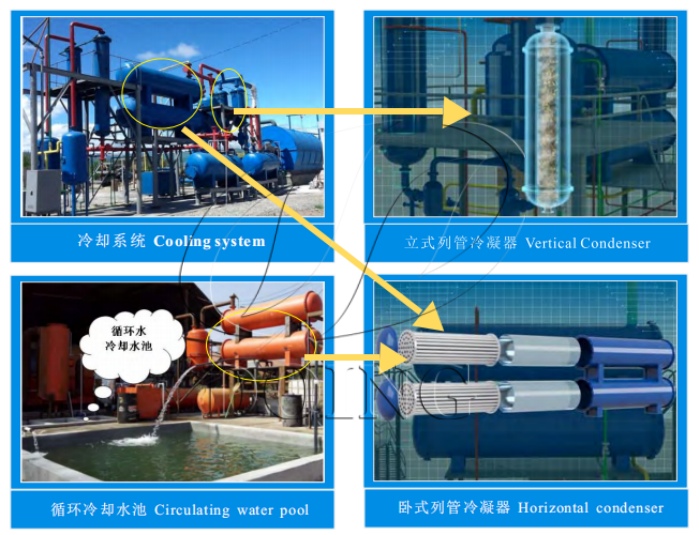
Pyrolysis plant water circulation system
What does leave the site is flue gas from the burner, and that is where local limits bite. The treatment train is built in stages: desulfurization and denitration at the base, dust removal next, further stages where the limit list is strict. Each stage is a separate module, so the train can be re-specified without redesigning the reactor.
Feed quality decides how much treatment is needed. PVC releases hydrogen chloride when heated, which corrodes the pyrolysis plant and is a dioxin source, so it is sorted out before feeding. Where the feed cannot be cleaned fully, activated carbon injection ahead of a baghouse captures what remains.
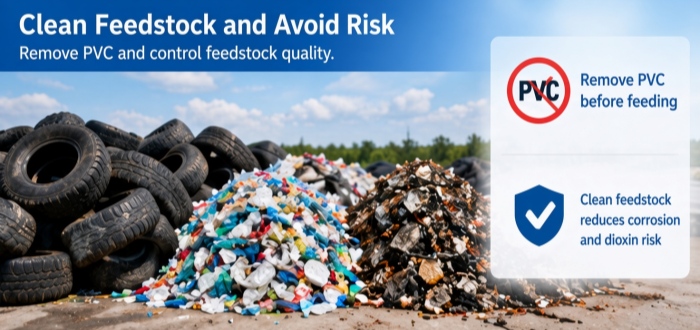
Clean feedstock and avoid risk
The configuration follows the limit list, not the price tag. A third-party SGS test report on DOING ECO’s pyrolysis plant arrangement shows the exhaust meeting the EU dioxin limit under EU 2010/75/EU and nine regulated pollutants within their limits, which is the kind of data an EIA file asks for.
| Gas treatment stages, from base to strictest | What it handles | When it is needed |
|---|---|---|
| Condensation recovery + non-condensable gas to burner | All oil vapour recovered; no direct process gas discharge | Base configuration in any jurisdiction |
| Circulating cooling water system | Cooling without process wastewater discharge | Any jurisdiction; removes a permit category |
| Desulfurization tower + denitration | Sulfur oxides and nitrogen oxides in flue gas | Most jurisdictions with SOx and NOx limits |
| Pulse dust collector | Particulate matter | Districts with particulate limits |
| Low-NOx burner + alkaline spray | Nitrogen oxides; cools gas for later stages | Districts with strict NOx limits |
| Activated carbon injection + baghouse | Dioxins and residual particulates | Where dioxin limits apply or plastic feed is strict |
| Wet electrostatic precipitator | Acid mist and fine particulates | The strictest limit lists |
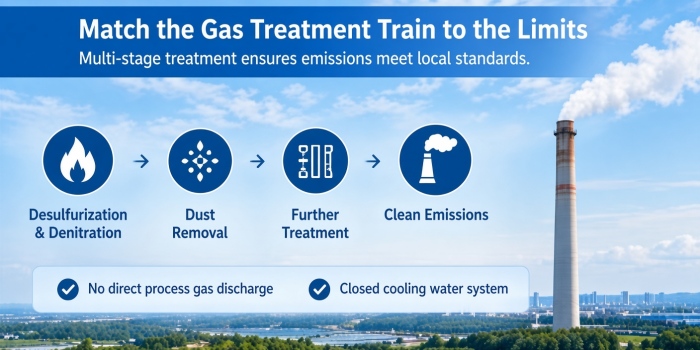
Gas treatment stages are selected according to local emission limits
III. The Paperwork: EIA and Permits
The EIA report is prepared by a third-party agency in your own jurisdiction, ideally one that works with the local environmental authority regularly. That agency needs technical material from the plant side, and the quality of that material decides whether the review moves or stalls.
The manufacturer supplies four things: emission data from the third-party test report, the plant layout with the footprint of each treatment stage, the utility list for power and water, and a technical description of the process. The agency folds those into the report instead of having to work out the plant from scratch.
Around the EIA sit the operation permit, the waste-handling licence and fire-safety acceptance; some jurisdictions add a project filing step. Permit work and fabrication can run in parallel.
One rule saves weeks: the configuration written into the EIA has to match the plant that arrives. A treatment stage added or dropped after the report is signed usually means an amendment, so the limit list, the quotation and the EIA should describe the same train.
| Task | Who does it | What it needs |
|---|---|---|
| EIA report | Customer's local third-party agency | Emission data, plant layout, site information |
| Emission and layout data for the EIA file | Pyrolysis plant maker | Test report, plant drawings, utility list |
| Operation and waste-handling permits | Customer + local authority | EIA report, site documents |
| Gas treatment configuration | Pyrolysis plant maker | The customer's local limit list |
| Installation, commissioning and training | Maker's engineers + customer | Site ready, civil works complete |
IV. Safety and Operating Compliance
Inspectors look past the stack. The reactor runs fully sealed at slightly positive pressure, so outside air cannot be drawn in during normal operation. That is a process requirement as much as a safety one, because oxygen reaching a heated reactor is a combustion risk.
Handling matters too. Carbon black and steel wire leave through a closed discharge, which keeps dust out of the working area, and the oil goes to closed tanks rather than open pits. Those two details are usually the first things an occupational safety inspector checks on site.
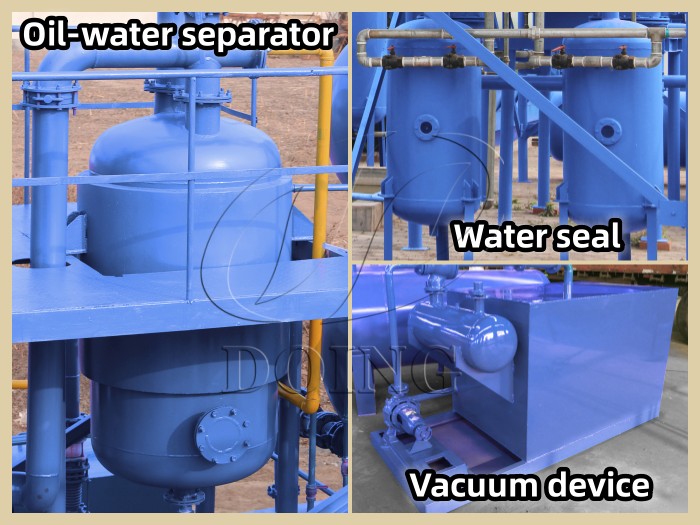
Around the reactor sits a safety chain: water-seal flame arrester, safety valve, pressure gauge, temperature alarm and explosion-proof electrical design, with automatic control of temperature and pressure. Each item is checked at assembly, then checked again at commissioning.
The operating side needs the same discipline: written operation and maintenance procedures, inspection records and trained staff. These are handed over at commissioning, together with operator training on site, because the files that satisfy an EIA are the same files an inspector asks for later.
Pressure gauges, safety valves and automatic controls support safe operation
V. Leave Room for Tighter Rules Tomorrow
Limits tighten over time, so the train should be built in modules, with floor space and duct connections left for another stage. When comparing quotations, ask whether the pyrolysis plant can take activated carbon injection or a wet electrostatic precipitator later without major rework.
Scale decides the reactor type as much as the rules do. For approved volumes around 20,000 tonnes per year or more, a fully continuous pyrolysis line is usually the workable choice, for the review process and for daily operation. Continuous lines are built from 15 to 50 t/d, while batch lines cover smaller volumes.
VI. How DOING ECO Works With Buyers on This
DOING ECO builds pyrolysis plants in batch, semi-continuous and fully continuous configurations and has delivered to more than 120 countries. The company works with CE certification and ISO 9001 and ISO 14001 management systems, and each project is configured against the customer's limit list rather than a standard package, with documents prepared for the EIA file.
FAQ
Send your local limit list, feedstock and planned scale. We will reply with a gas treatment train matched to the limits, the documents your EIA agency will ask for, and a plant proposal for that duty.
Request Information
Send your inquiry for further information