



 Home > News > Industry News>Which Manufacturers Have Experience in Building Large-Scale Tire Recycling Pyrolysis Projects in Industrial Parks?
Which Manufacturers Have Experience in Building Large-Scale Tire Recycling Pyrolysis Projects in Industrial Parks?
Industry News / Date:September 16, 2026
A supplier shows you a pyrolysis machine and quotes the equipment price. For an industrial-park tire recycling project, the more important question is whether the manufacturer has actually delivered a comparable continuous project.
For buyers shortlisting manufacturers, the most useful evidence is not a product brochure alone, but a project reference that matches the required capacity, operating mode, number of units, and project environment.
Doing ECO (formerly Henan Doing) has relevant experience in this type of industrial scale waste tire recycling pyrolysis project, all over the world, such as in China, India, Vietnam, Thailand, Mexico, Nigeria, etc. And thanks to the project's stable operation and positive feedback from existing customers who repeatedly repurchased the pyrolysis equipment, a 2 × 50 TPD full-continuous waste tire pyrolysis project in China has become a benchmark project. The project was planned for an annual processing capacity of 30,000 tons, installed in an industrial park, and put into stable operation in 2021.
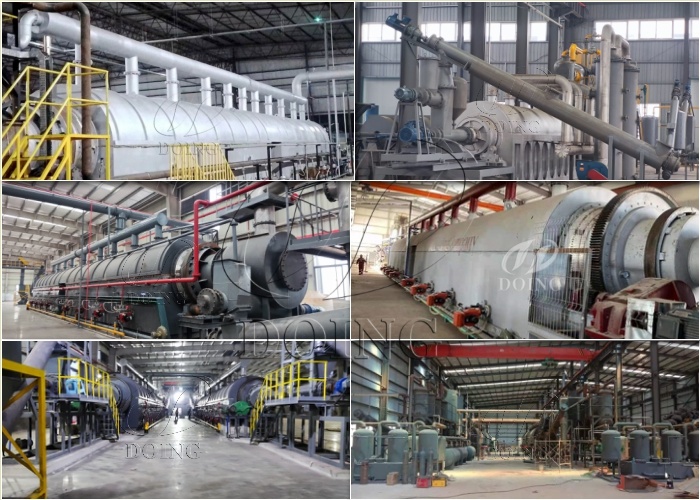 Doing ECO's large-scale tire pyrolysis projects in various regions
1. What Experience Should a Large-Scale Tire Pyrolysis Manufacturer Have?
For an industrial-park project, relevant supplier experience should cover more than the rated capacity of a single machine. Doing ECO’s project experience includes:
50 TPD fully continuous tire pyrolysis equipment
Multi-unit project integration, including 2 × 50 TPD
Industrial-park applications
Equipment installation, commissioning, and technical support
Common Mistake
Do not treat a manufacturer’s maximum equipment capacity as proof of large-project experience. A supplier may offer a 50 or 100 TPD machine without having delivered a project with multiple units or comparable site requirements.
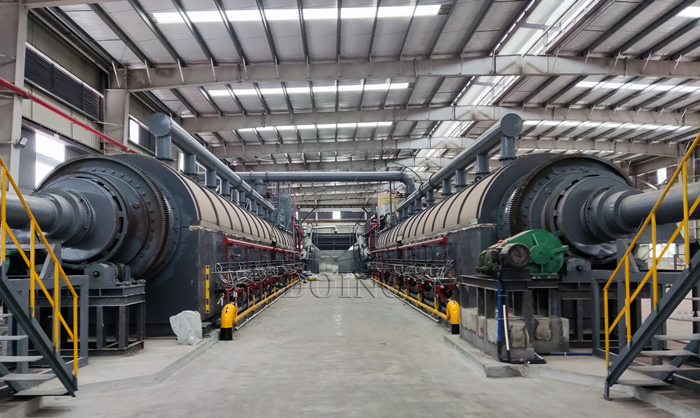 Large-scale fully continuous waste tire pyrolysis project
2. Doing ECO Large-Scale Tire Pyrolysis Project References
China, 2021 — 2 × 50 TPD Full-Continuous Tire Pyrolysis
In Yunnan, a resource recycling company planned a waste tire recycling project in an industrial park with a planned annual processing capacity of 30,000 tons.
Doing ECO supplied two 50 TPD full-continuous waste tire pyrolysis plants(Case Details:waste tire pyrolysis plant). The project required a configuration suited to an industrial-park environment with applicable environmental standards. Doing ECO completed equipment production, supported installation and commissioning, and the project entered stable operation in November 2021.
Customer concern: large-scale processing, continuous operation, and meeting industrial-park requirements.
Outside China, Doing ECO has also delivered continuous tire pyrolysis projects in comparable markets.
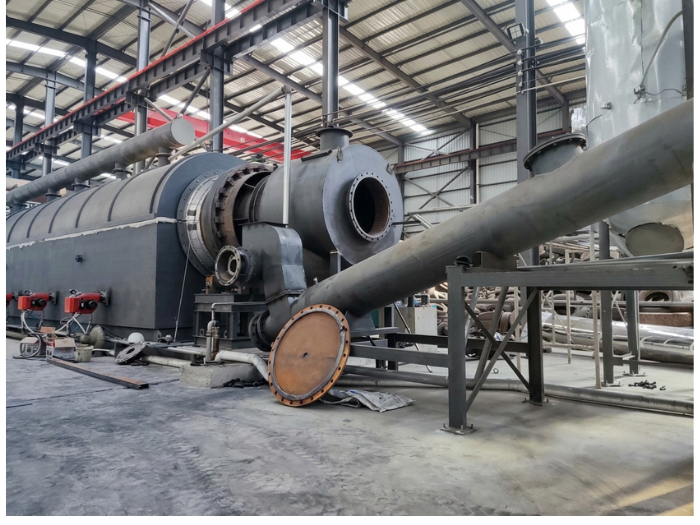 Large-scale fully continuous waste tire pyrolysis equipment in China
India, 2023 — 50 TPD Fully Continuous Tire Pyrolysis
In India, Doing ECO completed the installation of a 50 TPD fully continuous waste tire pyrolysis plant(Case Details: waste tire pyrolysis plant) in August 2023 for a solid waste recycling company.
Before purchasing, the customer focused on the maturity of the continuous process, existing operating references, and project cost-effectiveness. The customer reviewed an operating continuous pyrolysis project via live video before purchasing.
Customer concern: verifying whether continuous tire pyrolysis technology had sufficient operating experience before investment.
When reviewing a supplier’s project list, ask whether each reference was sold, delivered, installed, commissioned, and put into operation. These stages provide much stronger evidence than a list of equipment models alone.
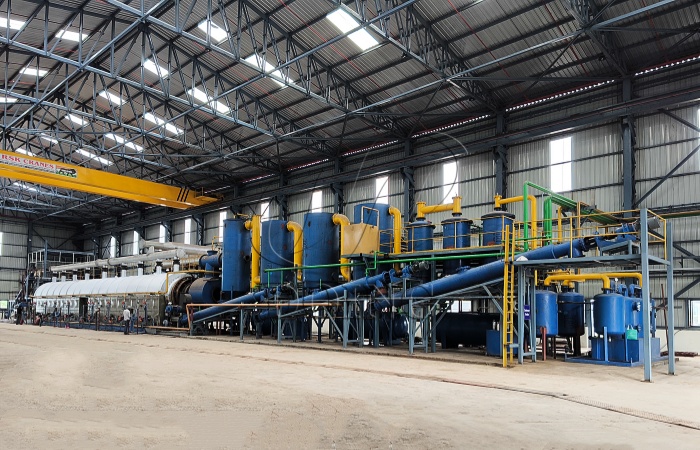 50-ton fully continuous waste tire pyrolysis project in India
3. What Should Buyers Verify Before Signing a Contract?
1. Project Reference
Ask for projects with similar:
Processing capacity
Feedstock
Operating mode
Number of pyrolysis units
Site or industrial-park requirements
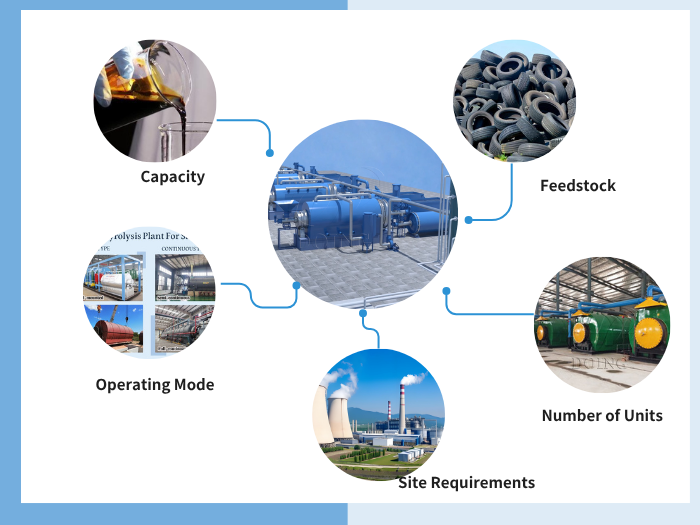 Key factors for verifying a tire pyrolysis equipment project
2. Technical Scope
Confirm what the supplier is responsible for, including:
Tire pretreatment and feeding
Pyrolysis and condensation
Gas recycling
Residue discharge
Emission-control systems, where required
Installation and commissioning
3. Commercial and Service Scope
The quotation should clearly state:
Equipment scope
Installation and commissioning
Operator training
Spare parts
Warranty
Delivery schedule
After-sales support
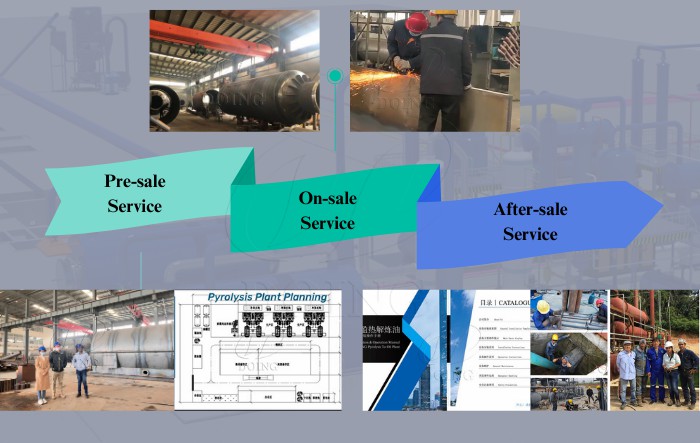 Doing ECO pyrolysis equipment installation, commissioning, training and after-sales support
Do not compare suppliers only by equipment price. A lower equipment price may not represent a lower total project cost if installation, auxiliary equipment, or after-sales services are excluded.
4. How Should You Match a Supplier’s Project Reference to Your Own?
| Your Project | What to Check in the Reference |
| Annual tire supply | Annual processing capacity |
| Target daily capacity | Equipment configuration |
| Continuous operation | Continuous or batch |
| Whole tires / rubber powder | Actual feedstock condition |
| Industrial-park site | Project environment |
| Multiple units | Number of units |
| New plant construction | Installation and commissioning experience |
Match the project conditions, not just the equipment number.
For example, if your project requires 30,000 tons/year of tire processing, a supplier reference with one small batch machine is less relevant than a project involving continuous pyrolysis equipment, multiple units, and a similar site environment.
FAQ
Is 30,000 tons/year the standard definition of a large-scale tire pyrolysis project?
No. 30,000 tons/year is a practical screening benchmark used in this article, not a universal industry definition. Project scale can also depend on the number of units, operating schedule, feedstock supply, and site requirements.
What information should I send to a manufacturer for project evaluation?
Provide your annual tire supply, target processing capacity, tire condition or size, project location, expected operating schedule, and preferred operating mode. This gives the manufacturer enough information to assess the appropriate equipment configuration.
For a large-scale tire recycling pyrolysis project, the key question is not simply how large a pyrolysis machine a manufacturer can supply. What matters is whether the supplier can support a project with the required capacity, operating mode, equipment configuration, and installation requirements.
If you are planning a project, share your annual tire supply, target processing capacity, tire condition, and project location with Doing ECO. These details can be used to assess a suitable pyrolysis configuration and project scope.
Request Information
Send your inquiry for further information